
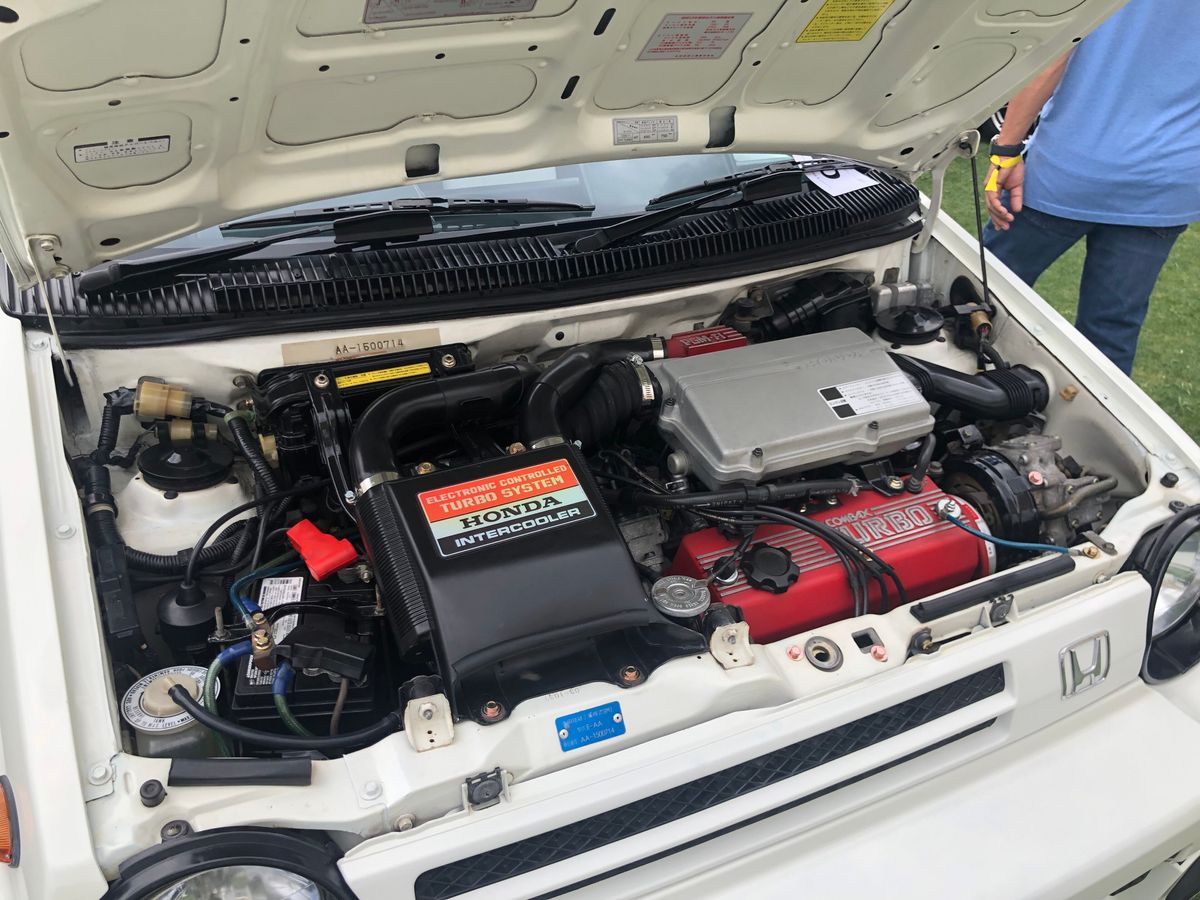
A turbo makes power by packing denser air into each cylinder. Squeezing that air also heats it, and hot air works against the turbo. The intercooler is the part that fixes that.
The short answer
An intercooler, which Garrett also calls a charge air cooler, sits between the turbo and the cylinders and cools the compressed air. Audi says compression heats intake air to between 120 and 150 °C, and hot air is less dense, so it carries less oxygen to burn. Garrett says cooler air lets more oxygen into the cylinders at the same boost, and lowers the risk of knock.
Why does boosted air get hot?
Compressing air makes heat, Garrett notes, so a turbo or supercharger warms the air it feeds. That costs power twice. Garrett says that as intake air temperature rises, density falls and the engine's computer may pull timing or boost.
How does an intercooler work?
Hella says an intercooler is built much like the engine's coolant radiator. Hot charge air flows through its core, and outside air or coolant carries the heat away.
Valeo, which makes intercoolers, says one drops inlet air from 130 °C to 60 °C and adds around 20% more power. Ram's owner's manual for the 2022 Ram 2500 and 3500 says the charge air cooler takes about 50 to 100 °F out of the air.
There's a trade-off. Garrett says good intercooling has to shed plenty of heat without causing too much pressure drop.
Air-to-air vs air-to-water
Hella describes two kinds:
- Air-to-air, or direct, coolers sit at the front of the car and use outside air. Ford's 2009 EcoBoost press information describes one. Mishimoto, an intercooler maker, calls the design simple, but it relies on airflow from vehicle speed.
- Air-to-water, or indirect, coolers pass the heat to coolant first. A low-temperature radiator then sheds it to the air. Mishimoto says water holds and moves heat far better than air, so the core can shrink, but it needs a whole second coolant system.
Some performance cars mount a water-cooled intercooler right at the engine. The 2021 BMW M3 and M4 have one built into the intake plenum, fed by an electric pump. Dodge put two air-to-coolant exchangers inside the 2015 Challenger SRT Hellcat's supercharger housing, designed to keep air below 60 °C even in extreme heat. In 2016, Porsche said its new 718 models would get indirect cooling, while the 911 kept direct cooling.
Front-mount vs top-mount
Mishimoto says a front-mount cooler sits in the grille, where the airflow is coolest, but its long piping can add turbo lag. A top-mount sits above the engine near the turbo. Shorter pipes mean quicker response, but it's more prone to heat soak. On the 2015 Subaru WRX, the hood scoop feeds the intercooler fresh air.
When Porsche redesigned the 911 Turbo S, it moved the coolers to the middle, over the engine and under the rear wing. They're 14% larger, and Porsche says the new spot cools much better.
What is heat soak?
Heat soak is when the intercooler itself gets too hot to do its job. Mishimoto says a hot engine bay or repeated hard runs can cause it. Garrett says a turbo working inefficiently pushes out hotter air and heat-soaks the cooler fast.
Some makers add a spray. The 911 GT2 RS that Porsche revealed in 2017 sprays its charge-air cooler with water at very high temperatures. Toyota fits an intercooler spray system to the 2026 GRMN Corolla to hold power steady at full throttle.
FAQ
Do superchargers have intercoolers?
Many do. Ford's 2020 Shelby GT500 tucks an air-to-liquid intercooler in the V of its supercharged V8. Jaguar's 2014 XF paired its supercharged V6 with a water-cooled one. More in turbo vs supercharger.
Does a bigger intercooler help?
It can. Ford gave the Focus RS it revealed in 2015 a much bigger intercooler to raise charge density. On the previous-generation BMW M3 and M4 (F80, F82 and F83), Garrett says its air-to-water upgrade cut intake manifold temperature by 10 °F on average.
Sources
- Turbo Tech 101 (Garrett Motion), read 2026-11-17
- Intercoolers: how do they work? (Garrett Motion), read 2026-11-17
- Intercooler core technology (Garrett Motion), read 2026-11-17
- Twin-turbo and intercooler upgrade for the 3.5L F-150 (Garrett Motion), read 2026-11-17
- Performance intercooler for BMW M3/M4 (Garrett Motion), read 2026-11-17
- Charge-air cooler (Audi Technology Portal), read 2026-11-17
- Intercoolers technical information (Behr Hella Service), read 2026-11-17
- Intercoolers (Valeo Service), read 2026-11-17
- 2022 Ram 2500/3500 owner's manual: charge air cooler (Mopar), read 2026-11-17
- EcoBoost technology press information (Ford), read 2026-11-17
- Air-to-water vs air-to-air intercooling (Mishimoto), read 2026-11-17
- How does an intercooler work? (Mishimoto), read 2026-11-17
- Guide to intercooler selection (Mishimoto), read 2026-11-17
- BMW M3 and M4 cooling system (BMW M), read 2026-11-17
- The new 2021 BMW M3 Sedan and M4 Coupe (BMW Group), read 2026-11-17
- 2015 Dodge Challenger SRT Hellcat (Stellantis), read 2026-11-17
- Charge-air cooling on the 718 (Porsche), read 2026-11-17
- 2015 Subaru WRX (Subaru of America), read 2026-11-17
- The new 911 Turbo S (Porsche), read 2026-11-17
- Porsche 911 GT2 RS world premiere (Porsche), read 2026-11-17
- 2026 Toyota GRMN Corolla (Toyota), read 2026-11-17
- 2020 Mustang Shelby GT500 (Ford), read 2026-11-17
- 2014 Jaguar XF (JLR), read 2026-11-17
- Focus RS output (Ford Europe), read 2026-11-17