
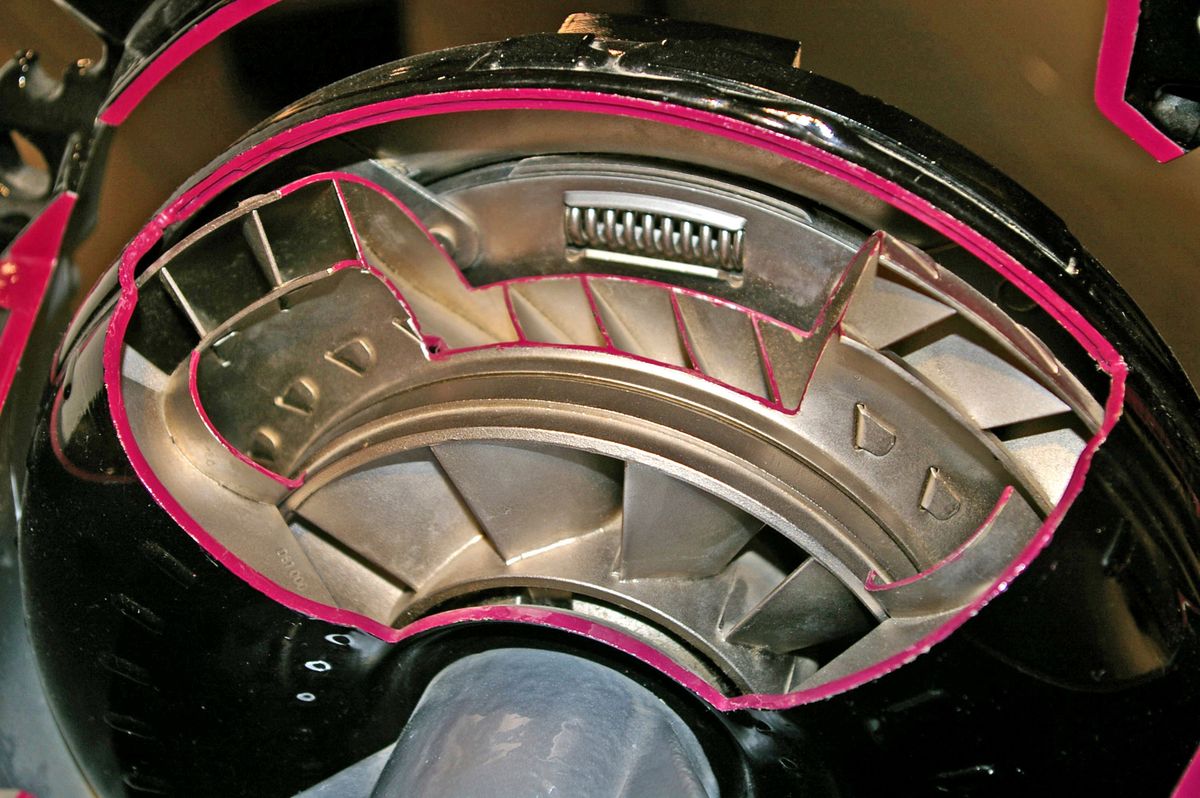
Stop at a red light in an automatic and the engine idles in Drive without stalling. A manual would need the clutch pedal down. In an automatic, the part doing that job is the torque converter.
The short answer
A torque converter sits between the engine and an automatic transmission and works like the clutch in a manual, ZF says. Inside are bladed wheels in a bath of transmission fluid: a pump turned by the engine, a turbine that drives the transmission, and a stator between them. The fluid carries the power, so the two sides can slip at a stop, and the stator lets the converter multiply torque when you pull away. Once you're moving, a lock-up clutch can join the engine and transmission directly.
What's inside a torque converter?
GM's guide to its 10-speed automatic lists four elements: a pump, a turbine, a stator, and a pressure plate splined to the turbine. Banks, a converter maker, describes what each one does:
- The pump, or impeller, is connected to the engine. With the front cover, it forms the converter's outer shell.
- The turbine is connected to the transmission's input shaft.
- The stator is a small finned wheel between the pump and the turbine. A one-way clutch holds it still.
- GM says the pressure plate, when applied, gives a mechanical direct drive from engine to transmission. That's the lock-up clutch.
Hyundai says the converter uses automatic transmission fluid to carry the power.
How does a torque converter work?
The spinning pump throws oil against the turbine and makes it turn. GM calls this a fluid coupling. At a stop with your foot on the brake, the turbine is held still while the pump keeps spinning, so the engine idles in gear. RevMax, a converter maker, says so little torque passes at idle that light pressure on the brake holds the car. Release the brake and the turbine is free to turn.
How does it multiply torque?
That's the stator's job. The one-way clutch holds the stator still, and its fins send the oil back to the pump. Sonnax says that redirection is what lets a converter multiply torque. GearStar, a transmission builder, puts typical stall torque ratios at 1.8:1 to 2.5:1.
As the car speeds up, the turbine catches the pump. At roughly 90% of pump speed, by GearStar's figure, the converter couples. It stops multiplying torque, and the stator spins freely with the turbine and pump. Allison says its converter's torque multiplication sends more power to the wheels, and that its converters give minimal rollback on grades.
What is stall speed?
Sonnax defines stall speed as the highest rpm the engine can reach while the transmission's output is held. Banks puts it as the engine rpm at which the converter passes the engine's power to the transmission.
What does the lock-up clutch do?
Fluid never passes all the power. Mazda says the drawback is fuel lost through the fluid, plus slip under hard acceleration, when road speed lags behind engine speed. Subaru says an unlocked converter can lose up to 10% of its input power. The lock-up clutch fixes that by locking the turbine to the pump, which GM calls a mechanical direct drive.
Today's automatics lock up early:
- Aisin says conventional automatics run locked in almost the entire range, except when starting.
- The 2019 Ram 1500's eight-speed automatics lock the converter at low speeds in every gear, 1st through 8th.
- GM's 8L90 lets its converter clutch slip a small, regulated amount to damp engine pulses.
- Mazda says SKYACTIV-Drive's much wider lock-up range gives a direct feel like a manual. Mazda claims 4 to 7% better fuel economy than its previous automatic.
Makers add dampers too. Schaeffler developed a centrifugal pendulum on the converter to cancel vibration from downsized engines. Mercedes pairs a twin-turbine torsional damper with centrifugal pendulum technology in the 9G-TRONIC's converter.
Do CVTs have torque converters?
Many do. Nissan says its XTRONIC CVT takes the engine's output through a torque converter. Honda says each CVT in the 2016 Civic Sedan has an engine-driven torque converter. The torque converter in Subaru's Lineartronic CVT partly locks up at about 9 km/h and fully at 24 km/h. More on that in CVT vs automatic.
Torque converter vs dual-clutch
Hyundai says a dual-clutch shifts faster and saves more fuel, while a torque-converter automatic puts low-speed smoothness first. See dual-clutch vs manual for how a DCT works.
FAQ
Is a torque converter a clutch?
It does a clutch's job through fluid. Most modern converters also contain a real clutch, the lock-up clutch.
Does a torque converter waste fuel?
Unlocked, it can. Subaru puts the loss at up to 10% of input power. That's why converters lock up as early as they can.
Sources
- SACHS torque converters (ZF Aftermarket), read 2026-11-16
- 10L90E transmission kit guide (Chevrolet Performance), read 2026-11-16
- 8L90 features and specifications (GM Powered Solutions), read 2026-11-16
- Torque converter (Hyundai Motor Group), read 2026-11-16
- What is a DCT transmission (Hyundai India), read 2026-11-16
- Understanding torque converters (Banks Power), read 2026-11-16
- Understanding stall speed (Banks Power), read 2026-11-16
- Torque converters 101 (RevMax), read 2026-11-16
- High-performance converters: stall speed and more (Sonnax), read 2026-11-16
- Talk the torque (GearStar), read 2026-11-16
- Torque converter (Allison Transmission), read 2026-11-16
- SKYACTIV-Drive (Mazda), read 2026-11-16
- Lineartronic CVT (Subaru Canada), read 2026-11-16
- GR-DAT automatic (Aisin), read 2026-11-16
- 2019 Ram 1500 technical sheet (Stellantis), read 2026-11-16
- Torque converter with centrifugal pendulum absorber (Schaeffler), read 2026-11-16
- The Mercedes-Benz S-Class (Mercedes-Benz USA), read 2026-11-16
- XTRONIC CVT (Nissan), read 2026-11-16
- 2016 Civic Sedan press kit: powertrain (Honda), read 2026-11-16