
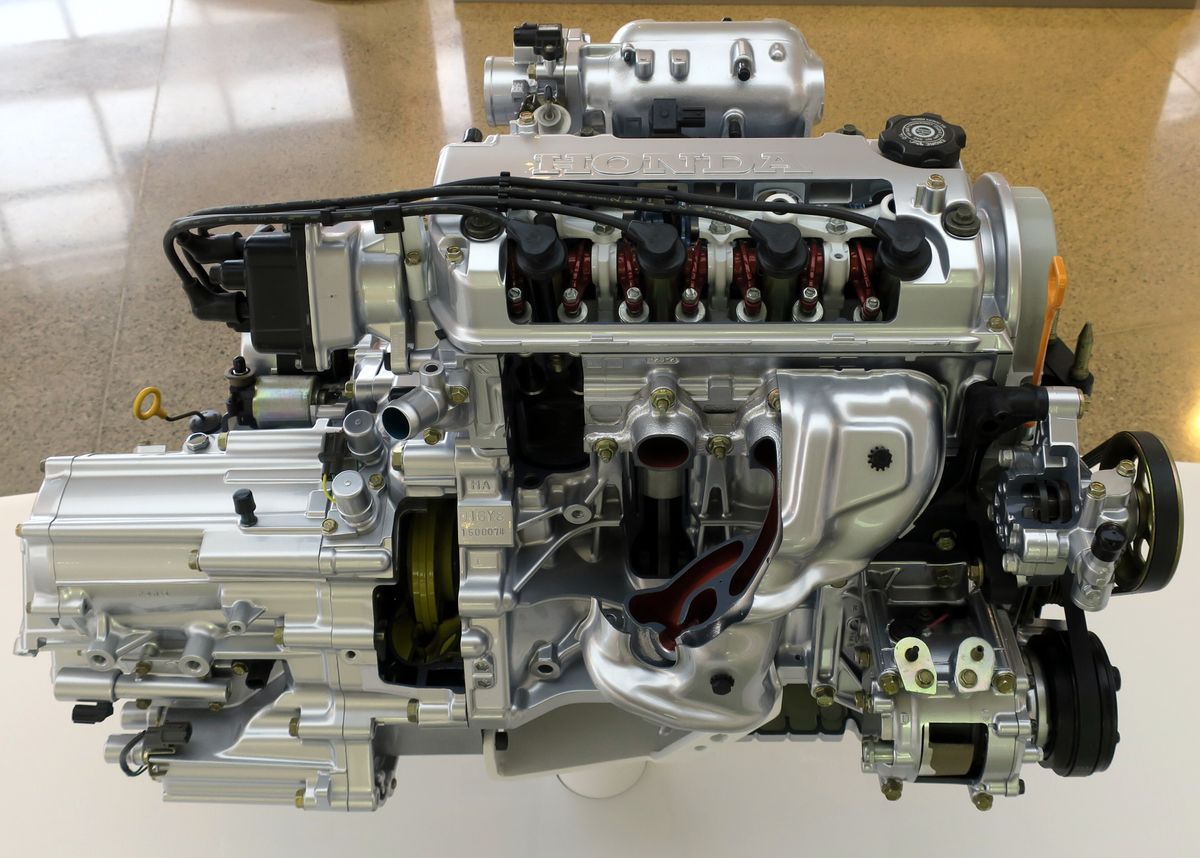
In 1989, Honda got 160 PS out of a 1.6-liter Integra engine without giving up on mileage. The trick was VTEC: one engine, two sets of cam lobes, and a pin that decides which set is in charge.
The short answer
VTEC stands for Variable Valve Timing & Lift Electronic Control System. Each pair of valves gets more than one cam lobe. At low revs, mild lobes work the valves. At a set engine speed, oil pressure pushes a pin that locks the rocker arms to a bigger lobe, so the valves open earlier, close later and lift more. Honda calls it the first commercially successful variable valve timing and lift technology in a production car.
Why give an engine two cam profiles?
Honda says high-revving four-valve engines traditionally gave up low-end torque to make their top-end power. VTEC was built to end that trade, combining good mileage with strong output across the whole rev range.
How does VTEC work?
Early VTEC engines had three cam lobes for each pair of valves:
- The two outer lobes open and close the valves at low engine speeds.
- The center lobe has longer duration, more lift and timing tuned for high-end power.
- Each lobe pushes its own rocker arm, and hydraulically operated pins are built into the rocker arms.
At the switch point, oil pressure pushes the pins across and the three rocker arms are joined. Hagerty notes that the pressure comes from the engine's own oiling system. Now the valves follow the center lobe. On the B16A, Honda did this on both the intake and exhaust cams.
The idea came from Honda's motorcycles. Honda says VTEC grew out of REV, a bike technology that shut off two of the four valves in each cylinder at low speeds.
When does VTEC kick in?
It depends on the engine. From Honda's own pages:
| Engine | Car | Output (Honda) | VTEC switch point |
|---|---|---|---|
| B16A | 1989 Integra | 160 PS at 7,600 rpm | about 4,800 to 5,200 rpm |
| SOHC VTEC | 1992 Civic Si/EX | about 5,000 rpm | |
| DOHC VTEC | 1993 Prelude VTEC | 4,800 rpm | |
| C30A V6 | NSX | 280 PS at 7,300 rpm (5-speed manual) | 5,800 rpm |
| F20C | S2000 | 250 PS at 8,300 rpm | high cam from 5,850 to 9,000 rpm |
The B16A made 100 PS per liter and revved to 8,000 rpm. The F20C's 125 PS per liter stayed the record for a mass-produced engine for 10 years.
What are VTEC-E, i-VTEC and VTEC Turbo?
- VTEC-E (1991) is the economy version. In normal driving it rests one intake valve and burns a lean mix for very low fuel use.
- Three-stage VTEC (1995) adds a middle step: one hydraulic circuit links two rocker arms, then a second links all three.
- i-VTEC (October 2000, the K-series) adds VTC, which continuously shifts the intake cam's position relative to the crankshaft.
- VTEC Turbo: Honda's 1.5-liter VTEC Turbo, the L15B, was first used in the 2015 Step Wagon. On the 2.0-liter K20C turbo in the Civic Type R, VTEC works only on the exhaust side, to help the engine breathe and cut pumping loss.
Not every turbo Honda switches lift, though. Honda's own release says the 1.5-liter turbos in the 2016 Civic and 2017 CR-V didn't use VTEC's variable valve lift.
Which cars still use VTEC?
Honda's 2026 spec pages list a 16-valve DOHC VTEC engine in the Civic Si and the Civic Type R. The Type R makes 315 hp at 6,500 rpm. Honda says the 2017 Type R used VTEC to change its exhaust valves' timing, lift and duration. At Acura, the Integra Type S's 2.0-liter VTEC Turbo makes 320 hp, the 1.5-liter Turbo in the Integra and ADX combines VTC and VTEC, and the MDX's 3.5-liter V6 uses i-VTEC.
On the street
To feel the high cam in an older VTEC car, you have to rev past the switch point. On a B16A that means holding a gear past about 4,800 to 5,200 rpm. Below that, the engine runs on its mild lobes. Bikes got it too: the 1999 Honda CB400 Super Four's HYPER VTEC ran on two valves per cylinder and switched to four above 6,750 rpm.
FAQ
What does VTEC stand for?
Variable Valve Timing & Lift Electronic Control System.
Is i-VTEC the same as VTEC?
It builds on it. In Honda's four-cylinder engines, i-VTEC is VTEC's variable lift and duration plus VTC, which shifts the intake cam's timing continuously.
What was the first car with VTEC?
The Honda Integra, which went on sale in Japan in April 1989 with the B16A.
Sources
- VTEC (Honda newsroom), read 2026-11-15
- The VTEC Engine, 1989 (Honda heritage), read 2026-11-15
- B16A: Honda's innovative engine with VTEC (Honda), read 2026-11-15
- C30A: NSX VTEC DOHC (Honda), read 2026-11-15
- 75 years of Honda, chapter 3: VTEC (Honda), read 2026-11-15
- 75 years of Honda, chapter 3, page 2 (Honda), read 2026-11-15
- 75 years of Honda, chapter 3, page 3 (Honda), read 2026-11-15
- VTEC history: F20C (Honda Japan), read 2026-11-15
- VTEC history: K20C (Honda Japan), read 2026-11-15
- 1991 Civic fact book: VTEC-E (Honda Japan), read 2026-11-15
- 1995 Civic fact book: 3-stage VTEC (Honda Japan), read 2026-11-15
- CB400 Super Four history (Honda), read 2026-11-15
- 2026 Civic Type R specifications (Honda), read 2026-11-15
- 2026 Civic Si specifications (Honda), read 2026-11-15
- Acura 2.0-liter Turbo VTEC engine (Acura), read 2026-11-15
- Acura VTEC technology (Acura), read 2026-11-15
- Here's what actually happens when VTEC kicks in (Hagerty), read 2026-11-15