
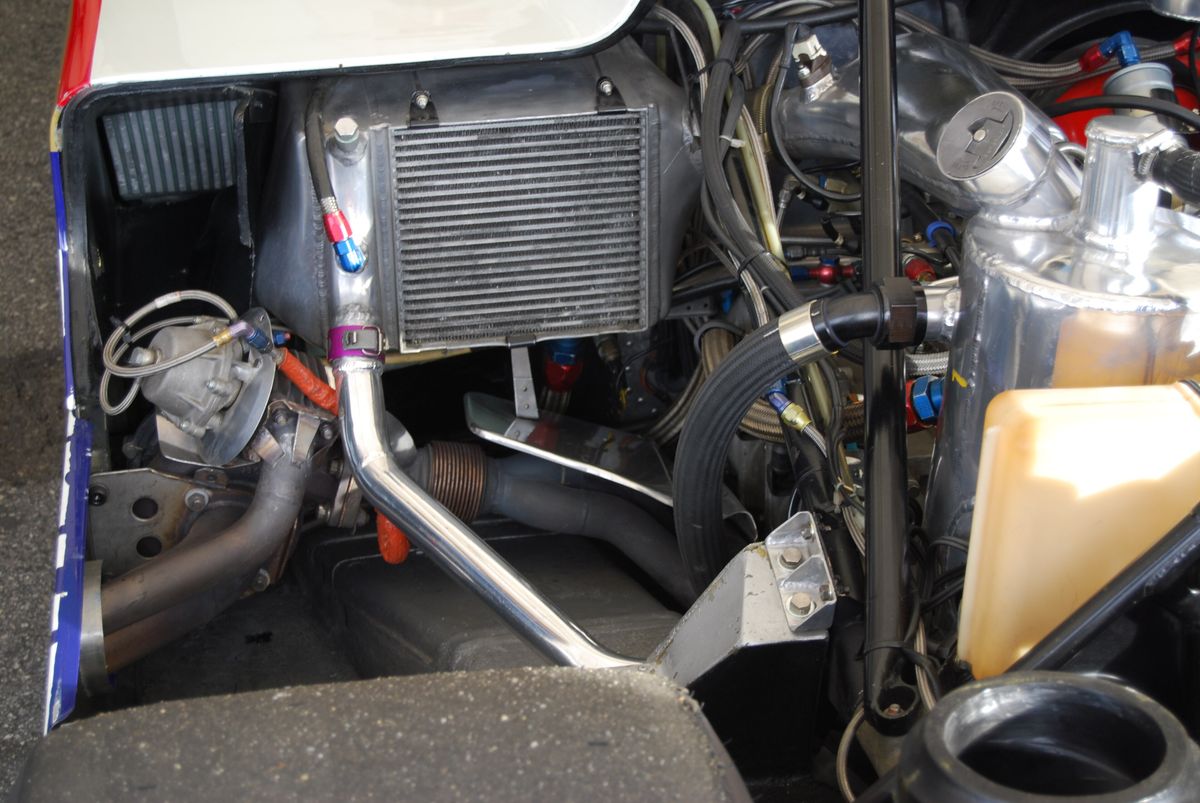
A turbo is spun by the engine's exhaust gas. Haltech says that flow has to be regulated, or the turbo can over-spin and fail. The wastegate is the valve that does the regulating.
The short answer
Garrett describes a wastegate as a spring-loaded valve that lets exhaust bypass the turbo's turbine. It's there to stop the turbo from over-speeding and the engine from over-boosting. A turbo can spin at more than 100,000 rpm, Haltech notes, and MAHLE says boost is usually capped so it doesn't destroy the turbo and the engine.
Why does boost need a limit?
Garrett says the only way to slow a turbo is to cut the flow reaching its turbine housing. Too much boost hurts in two ways. Garrett says boost heats the intake air, which raises the risk of knock, and more boost generally needs higher-octane fuel. MAHLE says that if a turbo keeps speeding up, its impeller can touch the housing or break apart.
How does a wastegate work?
Garrett says a wastegate balances boost pressure against spring force. A line feeds boost from the turbo into a port on the lower wastegate housing, while springs hold the valve shut until the pressure gets high enough. Mishimoto gives an example: on a turbo rated for 8 psi, that pressure compresses an 8-pound spring and opens the gate.
Springs set the baseline. Garrett's external gates come with 1 bar (14.5 psi) springs, swappable from 0.2 bar (3 psi) to 1.7 bar (25 psi). Turbosmart adds that a 14 psi gate may need 20+ psi to open on a bench test, because on the car, exhaust backpressure helps push it open.
To run more boost than the spring allows, you add a boost controller. Mishimoto says a manual one bleeds off pressure headed to the actuator, so the valve opens later. Haltech says an engine computer can instead pulse a boost control solenoid, changing how much boost the wastegate sees.
Internal vs external wastegates
Garrett describes two layouts:
- Internal gates are built into the turbine housing, with a flapper valve, an arm and an actuator. They're compact and simple, but the small valve flows less and can overboost in high-flow setups.
- External gates mount on the exhaust manifold or header. The bypassed gas can rejoin the exhaust further downstream, and the bigger valves give smoother boost control. They're larger and need extra fabrication.
Electronic wastegates
Some newer engines control the wastegate electronically. Honda says the electrically actuated wastegate on the 2017 Civic Type R lets boost be precisely controlled. Ford gave the 2017 F-150's 3.5-liter EcoBoost an electronic wastegate, and Subaru says the 2022 WRX's turbo has an electronically controlled one.
A wastegate can do more than cap boost. Toyota says the 2023 GR Corolla uses its wastegate control to help the catalytic converter warm up.
What about variable-geometry turbos?
Porsche's 911 Turbo of 2006, the 997 generation, paired variable turbine geometry (VTG) turbos with a gasoline engine. Its VTG turbos were built to handle the most exhaust the engine could make, so it needed no bypass valve, Porsche says. The 992-generation 911 Turbo S, introduced in 2020, pairs VTG turbos with electrically adjustable wastegate flaps.
What happens when a wastegate fails?
MAHLE says a gate that opens too early costs power at low rpm, while one that opens too late can let the turbo overspeed. When boost strays from its target, the engine computer drops into a fail-safe mode and cuts power sharply.
BMW of North America, for one, extended the warranty on the wastegate valve controller to 15 years or 150,000 miles for the 2019-2022 X2 M35i and 2020-2023 M235i xDrive Gran Coupe.
FAQ
Is a wastegate the same as a blow-off valve?
No. Garrett says the wastegate sits on the exhaust side and controls turbo speed. The blow-off valve sits on the intake side and vents boost when the throttle snaps shut, which keeps the compressor out of surge. More in turbo vs supercharger and what an intercooler does.
Did the original 911 Turbo have one?
Yes. Porsche says the 1974 911 Turbo regulated boost with a controlled valve on the exhaust side, which made the turbo engine usable every day. Porsche says it made 191 kW (260 hp) on a maximum of 0.8 bar.
Sources
- How turbocharger wastegates work: internal vs external (Garrett Motion), read 2026-11-18
- Types of turbo (Garrett Motion), read 2026-11-18
- What does an external wastegate do? (Garrett Motion), read 2026-11-18
- How a turbo works: advanced (Garrett Motion), read 2026-11-18
- Turbo Tech 101 (Garrett Motion), read 2026-11-18
- Wastegate vs blow-off valve (Garrett Motion), read 2026-11-18
- How turbo boost control works (Haltech), read 2026-11-18
- Turbocharger damage brochure (MAHLE), read 2026-11-18
- Turbochargers lose power (MAHLE Workshop Heroes), read 2026-11-18
- Manual boost controller operation (Mishimoto), read 2026-11-18
- FAQs (Turbosmart), read 2026-11-18
- Civic Type R powertrain (Honda), read 2026-11-18
- 2017 Ford F-150 (Ford), read 2026-11-18
- 2022 Subaru WRX press kit (Subaru of America), read 2026-11-18
- First-ever GR Corolla (Toyota), read 2026-11-18
- Turbo engines (Porsche Christophorus), read 2026-11-18
- The 911's drive systems (Porsche), read 2026-11-18
- 911 Turbo S (Porsche Australia), read 2026-11-18
- Wastegate controller warranty extension, SIB 01 02 25 (BMW of North America), read 2026-11-18